BLOG
Newsletter Vol. 49: When Learning IS the Strategy: A New Case Story + 2027 Openings
November 1, 2026
●
4 min

The Optimistic Anthropologist · Volume 049 · November 2026
Dear Reader,
It’s been a while, hasn’t it? I owe you an apology for the long silence since our last field report. The past 14 months have been full in the best and most challenging ways. Optimistic Anthropology (and my family) moved from Sarajevo back to Washington, DC in fall 2025. And you may or may not know what DC has been experiencing over the last few years (FreeDC is a great resource to learn more), but it led to a lot of my energy being called toward my local community.
On the work side, in 2026 I’ve been fortunate to learn alongside some remarkable people and collaborate on some inspiring projects in the United States and around the world! (See below.)
Through all of it, I’ve been reminded again and again that who we work with and how we work together matter immensely for what becomes possible.
If you’re new here, welcome! I’m Alison Gold. I founded Optimistic Anthropology in 2017 to help organizations, partnerships, and communities turn everyday insights into collective wisdom and develop cultures and strategies for social change. I believe that systems are made of people, and that collective learning work is strategy work for shaping a more just and joyful world.
These beliefs are at the heart of Optimistic Anthropology’s newest Case Story: How Might We Develop a Funding Strategy in Just 10 Weeks? This summer, the program team at a leading feminist funder focused on the Global South had ten weeks to evolve their funding strategy and launch a call for proposals. They wanted that strategy shaped by other funders and movement leaders, not just the staff of their organization. Instead of a traditional research project, Optimistic Anthropology designed and facilitated an Emergent Learning process that positioned the program team as co-learners and decision-makers from start to finish.

Case Story: How Might We Develop a Funding Strategy in 10 Weeks?
In the Case Story, I share HOW we used Emergent Learning and qualitative research to do the work as well as prompts that you and your colleagues can use in your own work. The Case Story also offers practical proof that learning doesn’t have to slow strategy down. It can be the strategy.
If this sparks something for your own work, I’d love to hear what you’re wrestling with. And please know that we’re now booking projects for 2027.

Be well, do good, and keep each other safe,
Alison
WORK WITH US
WE’RE BOOKING NEW PROJECTS FOR 2027!

Optimistic Anthropology has capacity for new projects in 2027, and we’d love to hear what you’re working on.
For nine years, we’ve partnered with changemaking teams and organizations across the U.S. and around the world (here’s what they say about us). In every engagement, we aim to model what we hope to see more of in the world. That means building trusting relationships and honoring the deep knowledge clients bring about their issues and the communities they work with and within. We pair that with our values of deep equity, joy, curiosity, humanity, and rigor to co-create learning cultures and transformational strategies for more just and positive world.
What can we help you make happen? Here are some examples from 2026!
Developing emergent learning cultures & strategies. This summer, we designed and facilitated a 10-week Emergent Learning process, grounded in feminist participatory research, to help one of the world’s largest feminist funders define the new strategy for a funding stream. The process drew on a material review and 27 conversations with funders and movement leaders working in and across the Global South. Read the case story.
Designing & facilitating learning experiences. Since 2025, we’ve helped Australia’s largest private charitable trust build its Emergent Learning capacity through an internal staff cohort, tailored group and individual coaching, and an in-person learning experience for all staff.
Serving as an independent learning partner. Together with a nationally-recognized casemaking organization, we designed, facilitated, and promoted a series of eight interactive workshops for a funder’s grantee network of voting organizers in the American South. Using an Emergent Learning approach, Optimistic Anthropology refined our outreach and facilitation as we went, growing registration to about 30 per session and engaging 125 people across the network.
Delivering workshops & webinars. We delivered the fourth iteration of our introductory workshop on theory of change for systems transformation to academic and staff teams at a leading research university.
If what we do and how we work sounds like what your organization or partnership is looking for (or might be), let’s connect! Email Alison or schedule a time to talk.
IN THE SHOP
PAY WHAT YOU WISH IN OUR SHOP

We believe social change practitioners deserve beautiful, thoughtful tools that enable collaboration and learning. In our store, we aim to share resources which grew from Optimistic Anthropology’s fieldwork with others in a pay-what-you-wish model so that the ideas and tools can spread.
VIST THE OPTIMISITIC ANTHROPOLOGY SHOP
THE LATEST
NEW LEARNING RESOURCES & OPPORTUNITIES

Blog Post: Planting the Seeds of Causal Thinking
I was thrilled to co-author this post with Kimberlin Butler for the Causal Pathways Initiative in October 2026. Our assertion is that causal thinking isn’t only for evaluators. It’s a practice anyone working toward systems change can use, with or without a formal evaluation. We share five questions at its core and offer simple ways to bring these questions into work you’re already doing, like strategy conversations, grantmaking, and learning sessions. Read the post here.
Recording: The Nitty Gritty of Causal Pathways Evaluation - In May 2026, Steve Powell (Causal Map Ltd) and I co-facilitated this free training for the Causal Pathways Initiative We covered building iterative evaluation design, what differentiates Causal Pathways from conventional evaluation, and coding causal relationships. Available in English and Portuguese.

Alison Gold and Steve Powell having a good time talking Causal Pathways Evaluation.

Some of the awesome participants from the 2025 Emergent Learning Open Enrollment Program together in Chicago!
Emergent Learning Open Enrollment Program Registration for 2027 is Open thru November 23! I love the practice of Emergent Learning and have been fortunate in the past to be a participant in this program and serve as a coach in it. If you’re interested in a great professional development opportunity, consider registering!
My wonderful colleague Madeleine McKinnon, PhD is the lead author of a new Foundation Review article, Spend-Down to Scale Up: Limited-Life Giving in the Climate Crisis. In it, she shares lessons from her work at Australia’s largest private charitable trust which is structured to spend down all of its resources. It’s full of great insights, plus a lovely shout-out to the Emergent Learning work I’ve been lucky to be part of.

(L to R) Madeleine McKinnon, Alison Gold, and Megan Weir at a March event in Melbourne, Australia.
/
SHARING OUR VALUES
JOY & CURIOSITY
In Optimistic Anthropology’s work, we often talk about our values which include joy and humanity, as well as rigor, curiosity, and deep equity. Since fall has been a season filled with joy and curiosity for us, we wanted to end this Newsletter with some little anecdotes and questions that hopefully will spark some joy and curiosity for you!

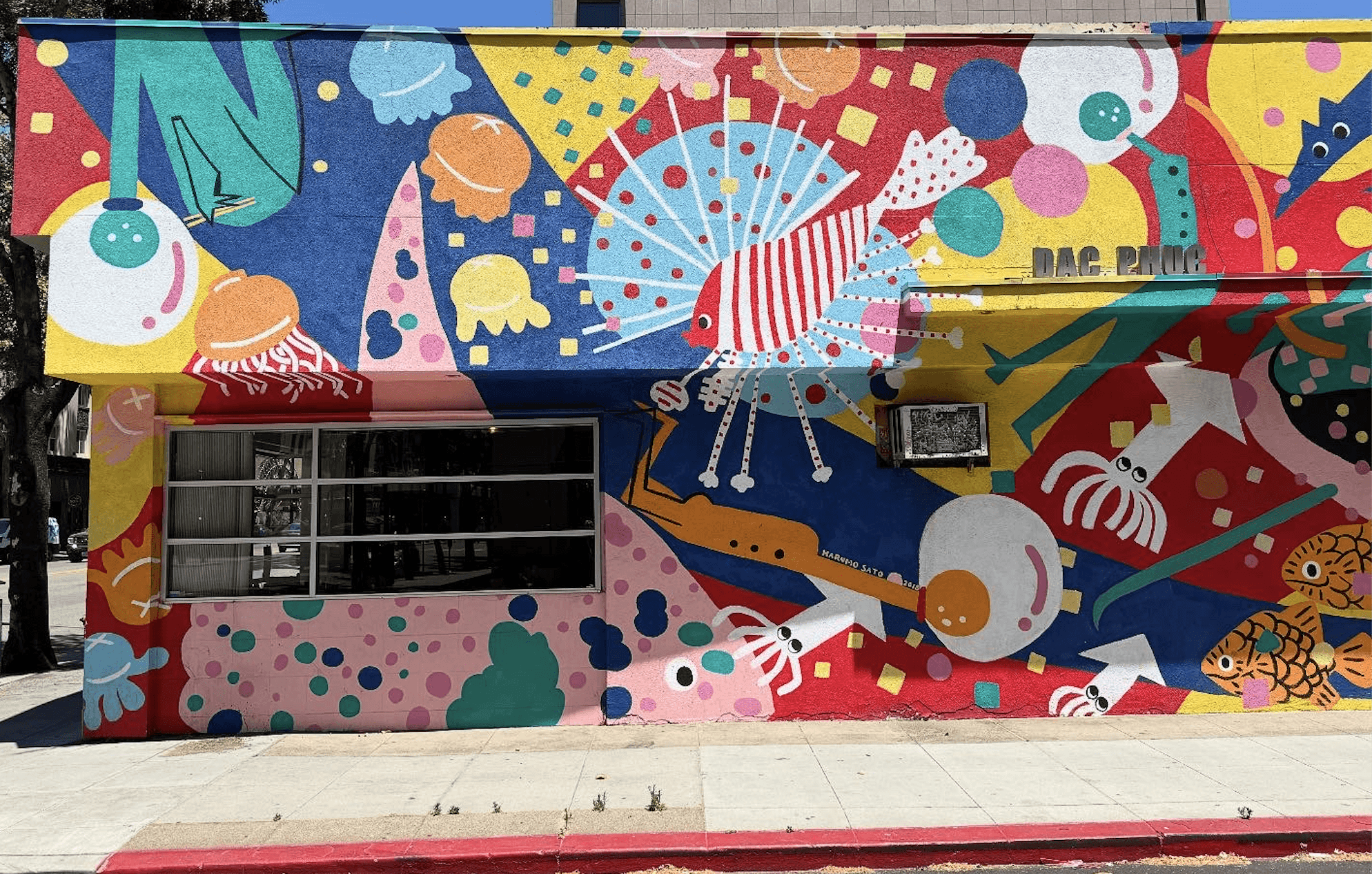
Local DC Artist Rose Jaffe always has a political mural in front of her studio. Dimi the Wonderdog - our beloved family pooch and office mascot is an immigrant from Bosnia-Herzegovina and was so excited to see the latest mural that he demanded a little photoshoot. Neighborhood walks, dogs, and art all spark joy for me. What’s sparking joy for you?

I love a research project almost as much as I love a crafting project! So, when my husband asked if I wanted to go to the Maryland Renaissance Faire I agreed to if I could research and make our costumes based on what our ancestors would have worn during that time period. Inspired by what an Ottoman-era Bosnian-Muslim man and a German-Jewish woman would wear (aside from my hat and sunglasses which were to protect against migraine) we represented our cultures! What’s been igniting your curiosity recently?